



The optimal solution!
The rear-ventilated facade is considered the best facade system in terms of building physics. We would like to explain to you in more detail below why this is the case.
The curtain ventilated facade
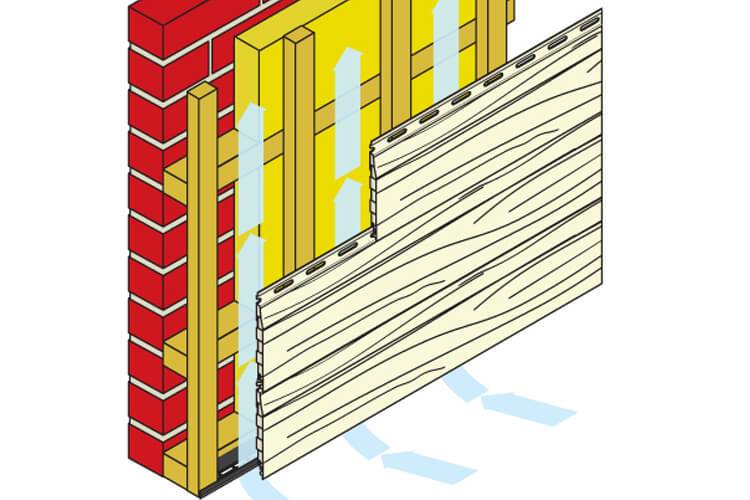
A curtain ventilated facade is mounted on a substructure, that is, behind the weatherproof outer layer the wall continues to breathe Diffusing residential or building moisture is carried away by the air flow behind the curtain wall - this will also allow masonry that is already damp to dry out without any problems.
With a rear-ventilated facade, the functions are clearly separated into weather protection, rear ventilation, thermal insulation and load-bearing wall. Ventilated facades have proven to be ideal on thousands of houses with hundreds of thousands of square meters. They therefore offer the highest level of safety and cost-effectiveness with little maintenance effort.
Advantages at a glance
- clear separation between weather protection and building structure
- Moisture is continuously removed
- This permanently prevents the formation of mold
- ideal for energy-saving insulation measures
- Dew water point is shifted outwards
- Assembly possible without special tools
- pleasant living environment in winter and summer
- Weatherproof - crack bridging - soundproofing
Structure of the rear ventilated facade
- clear separation between weather protection and building structure
- Moisture is continuously removed
- This permanently prevents the formation of mold
- ideal for energy-saving insulation measures
- Dew water point is shifted outwards
- Assembly possible without special tools
- pleasant living environment in winter and summer
- Weatherproof - crack bridging - soundproofing
Structure of the rear ventilated facade
The facade cladding is the building envelope and protects the insulation and masonry from external weather conditions such as cold, wind, rain and sun. There is a wide range of different materials to choose from, such as wood, plastic, fiber cement or other composite materials. In addition, a large number of these materials are characterized by advantages such as freedom from maintenance, longevity and weather resistance.
The rear ventilation is the essential component of a well-functioning curtain wall. Rear ventilation is the airspace between the facade cladding and the load-bearing wall or the facade cladding and the thermal insulation. The air must be able to circulate unhindered from bottom to top. Moisture is therefore permanently transported away.
The facade insulation usually consists of mineral insulation materials. The rear ventilation creates a clear separation between the facade and the thermal insulation. The rear ventilation keeps the thermal insulation dry and permanently functional.
The substructureis the direct link to the load-bearing wall. The substructure is predominantly made of wood (roof battens) but can also be made of metal depending on the system requirements. The structure of the substructure is determined by the product in question - or whether additional insulation is to be used.
Graphical representation

Heat, cold, sound and building protection
How pleasant or comfortable we feel in a room is due not only to the temperature of the ambient air, but also to the radiant temperature of the surrounding areas. That's why the temperature on the thermometer doesn't say anything about comfort.
People feel most comfortable when the air temperature plus the temperature of the surrounding areas corresponds to their body temperature of around 37°C.
Example 1: The surrounding areas have 17°Celsius. Then the room air must be heated to °20 to create and feel comfort.
Example 2: In summer, of course, things are exactly the opposite. If the temperature of the walls rises to °20 due to sunlight, the air temperature should actually be cooled down to °17 in order to feel the same comfort.
A curtain and ventilated facade In combination with additional and individually adapted mineral facade insulation, it has an extremely positive influence on the feeling of comfort inside the living area.
In the warm months, the outer facade heats up and protects the actual masonry through the rear ventilation. In addition, mineral insulation protects the interior from heat radiation from outside.
In the winter months it is exactly the opposite. The insulation offers the greatest possible heat storage for the building. The combination of curtain and ventilated facades with mineral insulation materials significantly improves the soundproofing of the house. They are effective protection against noise from the outside in and from the inside out.
Building physics basics
The following chapter informs you about the most important building physics laws and their effects. In science, this field of activity is also called building physics. The events that take place in the outer walls of houses can be divided into external and internal influences.
The outer ones are weather-related - cold, wind, rain, sun – and well known. Moisture and excess air pressure have an effect inside. These have received less attention in the past. This was not necessary with natural construction methods using natural building materials. However, if you do not take these building physics relationships into account when it comes to modern construction methods and building materials and take the wrong measures, you can suffer significant structural damage in the future.
The room humidity
The room humidity is created by cooking, baking, washing, showering, drying laundry, etc. and, last but not least, by your own body fumes. This means that the air in the living spaces is constantly enriched with moisture. You can easily determine how much moisture the human body evaporates if, for example, the windows fog up within a very short time in a closed, unheated car in winter. If this moisture couldn't get out of the rooms, you'd soon feel like you're in a rubber or plastic bag in your apartment. A wet room climate would arise.
Graphical representation of room humidity
The excess air pressure
Heating creates higher air pressure indoors because air, like most other substances, expands when heated. Although the pressure difference compared to the outside air is not large, it is still present permanently throughout the entire heating season. The higher internal pressure is generated even in closed rooms solely by exposure to the sun. As an example, the car again. If that has been in the sun for a while, the temperature difference is clearly detectable, only in air-conditioned rooms can the pressure difference be reversed exactly when the room temperature is cooled below the outside temperature. To prove it, an example: Open the freezer for a moment, close it again and open it again after a few seconds. If it is well sealed, you will clearly notice the pressure difference.We have to remember one thing from this: „In uncooled rooms, the pressure gradient always goes from the inside out„. This is important because vapor diffusion follows the pressure gradient.
